
Finding Bourne Residents Through Records
A Bourne residents directory is really a stack of records with different jobs. The property card names an assessed owner and parcel. A deed names the parties to a transfer. An annual register can document a civic record, within state limits. An old directory or archive volume gives a dated household lead. None of them lists everyone at an address.
Start with a testable name, address, village, or year. For a current property question, begin with Bourne Assessing. For a past household, try a directory year or the Bourne Archives. A name tied to an estate belongs in probate. Material that is not online can be requested from the Town Clerk, who serves as Bourne's Records Access Officer and keeps the record, the keeper, and the date clear from the start.
- Search the Bourne Assessor's Database by address, owner, or parcel to identify the assessed property record.
- Use the owner name in the Barnstable Registry research system and check the recorded instrument.
- For an individual checking their own registration, use the Massachusetts voter-status form with the required identifying fields.
- Match a historic name to a dated directory, Archives item, census, or probate file before treating it as a household lead.
- Send a focused request to the relevant custodian when an online index does not contain the record.
Bourne Residents Records Offices
Bourne records are split by function. The Town Clerk keeps vital, election, and street-list records. Business certificates, dog licenses, and Town Meeting material live there too. Assessing handles appraisal and parcel facts. The Barnstable Registry of Deeds keeps title history, the courts keep dockets, and choosing the right office spares you from asking a title desk for tax facts.
Barnstable County Registry of Deeds
3195 Main Street
Barnstable, MA 02630
508-362-7733
Bourne Assessing Department
Bourne Town Hall, Room 104
24 Perry Avenue, Buzzards Bay, MA 02532
508-759-0600 ext. 1510
Bourne Town Clerk and Elections
Bourne Town Hall, Room 103
24 Perry Avenue, Buzzards Bay, MA 02532
508-759-0600 ext. 1505
Street-level parcel work belongs on the Bourne street directory path. The address, map, and deed chain stay together there.
Bourne Assessor Search Fields
The assessor database is the most direct starting point for a Bourne record search tied to property. It is a fiscal record, not an occupancy statement. The town's instructions say to put the number in ST NO 1. Use only the first street letters in LOCATION. Owner searches work best from surname initials. Combined fields get treated together, so one old value can block a match.
Record the situs address, owner mailing address, map, block, and parcel from the card. Add the assessment year and any linked PDF. A mailing address can sit outside Bourne. An exemption or property type is a record clue, not proof of who lives there now.
| Bourne assessor field | Practical entry rule |
|---|---|
| ST NO 1 | Enter the house number, not the street text. |
| LOCATION | Use the first 3-4 street letters and omit the suffix. |
| OWNER NAME | Use the first letters of the surname and review multiple results. |
| Map / Block / Parcel | Map uses a letter-hyphen-two-digit form such as A-01; block and parcel have no leading zeroes. |
Note: The FY2026 assessor system reports values as of January 1, 2025, so compare its date with the date on any deed.
The Bourne Assessor's Database shows the current search interface and local office details.
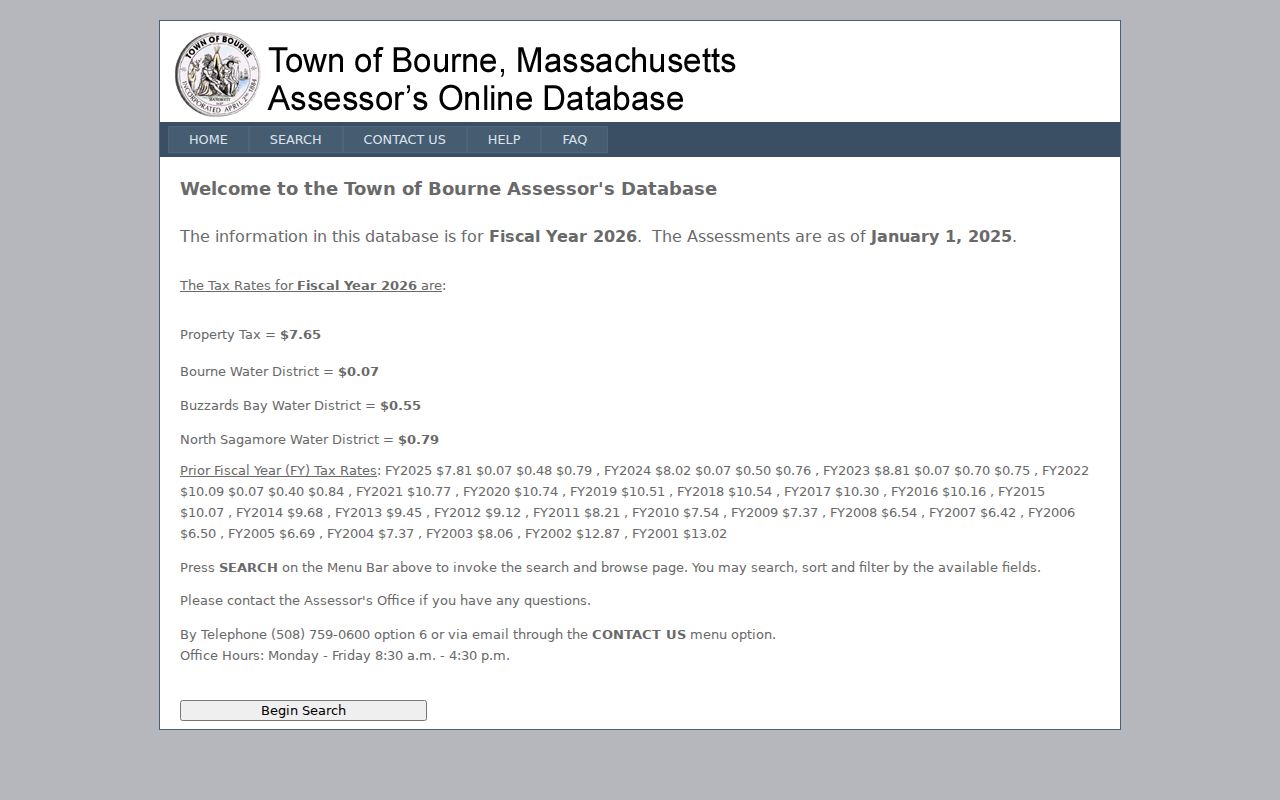
The official property source begins with a parcel or owner query. A separate record must confirm any relationship.
Bourne Deed Names and Title
The Barnstable Registry gives Bourne title research a long trail. Its legal index reaches back to 1742. The index is name based. Search a surname, an optional first name, a party role, a document type, Bourne as the town, and a date range. Wildcard and exact-name tools are permitted. The Registry advises testing spelling variants, and the roles matter when you follow a property backward: a grantee receives an interest, while a grantor transfers one.
Property-address search is only a discovery aid. That field began in August 1993. It holds submitted address text and is unofficial. Start with the assessed owner, run the official name search, and read the deed. Then search the seller as a grantee in the prior period, and ask Registry staff for help with older or oversized material, since much of the index and image collection is online.
| Official record trail | Best use | Important limit |
|---|---|---|
| Assessor property card | Find an assessed owner and parcel key | Does not establish current occupancy |
| Registry name index | Verify a recorded title party and instrument | Names a transaction relationship, not a resident roll |
| Registry address aid | Find likely post-1993 address leads | Unofficial and incomplete by the Registry's notice |
Free Registry research images carry a not-official-copy overlay. Clean prints use the cart's per-page rate. For a question about a person rather than a parcel, the Bourne resident lookup workflow uses a second independent keeper.
Current Bourne Residents Directories
Current Bourne resident directories work best as a set of specialized rolls. The assessor names an assessed owner and parcel. The Registry names recorded parties. MassCourts can surface public case-party associations. The voter form exists for an individual to confirm their own registration, and the Clerk's annual-register and street-list material carries its own rules of access and confidentiality.
| Bourne source | Relationship shown | Custodian | Access route |
|---|---|---|---|
| Assessor card | Assessed owner, situs, mailing address, parcel | Bourne Assessing | Free online search and office contact |
| Recorded deed index | Grantor, grantee, document, legal description | Barnstable Registry | Free index and overlaid images |
| Voter status | An individual's own registration status | Massachusetts Elections | Self-service form with identifying fields |
| Public docket | Public party and case association | Massachusetts Trial Court | MassCourts and clerk assistance |
| Town records | Defined municipal record or historic street list | Bourne Town Clerk | Counter, request, or repository access |
Each source uses its own snapshot date. A tax assessment, a recorded deed, a voter status result, and a docket event stay different records. A shared name alone proves little.
Bourne Voter and Court Checks
Massachusetts offers a voter registration status form for residents to check their own entry. It asks for a first and last name. It also asks for a birth date, residential ZIP code, and an agreement checkbox. A miss can mean a name variation. It can mean an old ZIP after a move. It can also mean a recent registration, inactive status, or a protected record. It is built for the individual voter, not a Bourne street-by-street resident list.
MassCourts searches by Name, Case Type, Case Number, or Ticket and Citation Number. The Name tab covers civil matters only, with capitalization and minimum-character rules. A party may appear more than once in one case. Open the case number. Compare date and court. Rely on the clerk for files, certified copies, or any record that stays out of view. Sealed, impounded, juvenile, and protected matters do not surface as ordinary public results.
- Roll
- A list made for a defined public purpose, such as civic administration, rather than a full list of all residents.
- Index
- A finding tool that points to a record. It may not include the complete record image or all related documents.
- Docket
- The court's case-event record, which is different from the complete case file.
- Parcel
- A mapped unit of property identified by local assessment or legal-description keys.
Bourne Town Clerk Request Paths
For Bourne records outside a county index, the Town Clerk is the natural first stop. It handles the town's own paperwork. The office keeps vital records, annual street-list and election material, Town Meeting records, business certificates, and other town files. Room 103 of Town Hall holds the office. Town Hall sits at 24 Perry Avenue in Buzzards Bay. Listed hours run Monday through Friday, 8:30 a.m. to 4:30 p.m.
A request under the Massachusetts Public Records Law, M.G.L. c.66, §10, works best with clear details. Name an existing record, a date range, a format, and a custodian. Bourne's form gives the first 20 minutes free, then states its labor and copy charges. The law does not force the Town to build a new list. Nor must it answer a broad question. Historical Archives items follow repository rules rather than any assumed online index.
Bourne Vital Record Windows
Bourne vital certificates reach researchers through more than one door. Locally, the Town Clerk handles vital requests. She takes birth, death, and marriage requests in person, by mail, or through the Town payment centre. Mail requests need the person's name, the event date, payment, and a self-addressed stamped envelope. The town's live fee page listed $10 per certified copy. A later Town Meeting proposal described changes. So confirm the amount with the Clerk before sending anything.
Statewide RVRS records run from 1936 forward with no public online index. RVRS accepts mail, in-person, and online or phone orders. It also offers onsite research indexes. The Massachusetts State Archives holds 1841-1935 material. Bourne Archives keeps town vital records from 1884-1914. Under M.G.L. c.46, §2A, birth and marriage records over 90 years open to genealogy. Death records over 50 years do too. Special restrictions still apply. Remember that a vital record documents an event. It does not serve as an open current-resident search.
Bourne Villages Change Searches
Village naming is a real Bourne record-search obstacle, not a cosmetic quirk. Modern sources use Buzzards Bay, Bournedale, Cataumet, Monument Beach, Pocasset, Sagamore, or Sagamore Beach. Older material tells a different story. West Sandwich meant Bournedale. North Sandwich meant Sagamore. Monument meant Bourne Village. Head of Bay meant Buzzards Bay. Bourne was incorporated from Sandwich in 1884. So a pre-incorporation search often belongs under Sandwich as well as Bourne.
The Town Report identifies six residential ZIP codes. Yet postal geography is not a town boundary. Verify a specific delivery address with USPS. Use MassMapper for visual parcel context. And search Registry property by town and legal description rather than ZIP. The Cape Cod Canal's construction also reshaped the physical setting around historical addresses. A missing modern label can simply be a naming change, not a missing family.
Historical Bourne Resident Directories
Historical Bourne residents directories sit scattered across institutions. The clearest digitized volume is the 1903 Resident and business Directory of Bourne and Falmouth Massachusetts, published by A. E. Foss & Co. NARA's directory table shows combined Cape coverage for 1903, 1908, 1926, and 1929. State Library leads include 1900, 1903, 1908, and 1926. Combined coverage demands care. Check the village heading and the volume itself before assigning any entry to a Bourne household.
An entry can supply a spelling, an initial, an address, or an occupation. It can also give a business clue tied to that edition's date. Pair it with census, probate, deeds, or a vital record. Do not read it as an unbroken timeline. The full shelf, the entry-reading method, and the household tracing process are gathered on the Bourne city directory page.
Bourne Archives Family Evidence
Bourne Archives collections add the deepest local historical layer. Holdings include town records, family collections, photographs, maps, and oral histories. The archive also keeps cemetery material, property records, village files, and digitized high-school yearbooks. The collection description also lists birth, marriage, and death certificates from 1884-1914. Public hours are limited to Tuesdays, with appointments. So bring a surname, address, village, and date range to make the inquiry count.
The Jonathan Bourne Public Library offers another in-person channel. Its genealogy resources include Ancestry Library Edition, Fold3 Library Edition, and HeritageQuest for in-library use. Ask staff about newspaper, obituary, directory, or yearbook holdings. Do not assume a complete run is digitized. These collections shine for a reunion, a family connection, or the history of a Bourne house.
Bourne Records Span Two Histories
Bourne's paper trail splits in two. Barnstable title records reach back to 1742. The historic probate index goes even further, to 1686. Bourne itself did not become a town until April 2, 1884, so Town Archives material from the incorporation era sits beside older Sandwich and county evidence. The 1913 Canal project redrew local geography. An old map, deed description, or village name may place a family somewhere different from a current street view.
That long span helps only when dates stay attached to each record. Begin early property trails in the Registry name index. Include Sandwich terms before 1884, and use the 1880 and 1906 atlases plus Sanborn materials to test road and structure context. The history also explains why no single Bourne record source can answer every period.
Bourne Archive Access Keeps Moving
Bourne's records now live across several access points. The Registry's index and many images are online. The town posts current property-card guidance and historical-map links. Bourne Archives offers digitized images and yearbooks alongside appointment-based material. The library keeps its genealogy databases for in-library research. A search that stops at one website can miss the record still sitting on a repository shelf or with its original custodian.
Court access is also in flux. Barnstable Superior Courthouse construction closed the public building in 2026, moving operations to the First District Courthouse, with reopening anticipated in Summer 2027. Use MassCourts first. Call the clerk before any in-person visit. Ask whether an archived file needs retrieval. The State Library also launched an additional digital archival platform in 2026, a good reason to revisit Bourne maps, town reports, and historic material when a catalog changes.
Bourne Privacy and Match Limits
A match needs a limit, not just a source. Massachusetts protects confidential voter registrations. The Address Confidentiality Program can give eligible participants a substitute mailing address. Federal law controls DMV information. Courts can limit sealed, impounded, juvenile, adoption, and other protected matters. Utility accounts and private association memberships are not public resident rolls.
Use the smallest field needed to answer the question. A parcel identifier can settle a map lookup. A docket number can be enough for a court follow-up. When a record looks wrong, ask the custodian about its correction route rather than republishing it.
Note: An assessed owner, recorded party, postal label, or directory entry is evidence of a dated relationship, not proof of present occupancy.