
Bourne City Directory Collections
Bourne’s directory evidence is spread among institutional shelves and digital items. The clearest online item is a combined Bourne and Falmouth resident-and-business volume at the Osher Map Library. The National Archives directory table also identifies a combined Barnstable/Falmouth, Bourne run. The State Library’s directory and voting-list collection is the right shelf for surname-organized books, possible house guides, business listings, and advertisements. A catalog year means a lead to inspect, not proof that every village or street appears in that volume.
| Collection | Years | Where held | Access |
|---|---|---|---|
| Bourne/Falmouth resident and business directory | 1903 | Osher Map Library | Digitized item metadata and image |
| Combined Barnstable/Falmouth, Bourne directories | 1903, 1908, 1926, 1929 | NARA, State Library, and partner libraries | Catalog, onsite, or digitized copy |
| Bourne directory catalog leads | 1900, 1903, 1908, 1926 | Massachusetts State Library and partner genealogy libraries | Confirm the item and access method |
| Boston Public Library Bourne material | 1903-1931 catalog lead | Boston Public Library | Exact shelf number was not located |
| Bourne High School yearbooks | Digitized collection | Bourne Archives | Online images and repository help |
There is no official confirmation of a separate Bourne reverse or criss-cross run. Some Massachusetts directories do include address-organized house guides, so inspect the front matter and street section of the actual book before assuming one exists. That caution keeps the volume from becoming a false address list.
Bourne's 1903 Directory
The Osher Map Library’s digitized directory record identifies Resident and business Directory of Bourne and Falmouth Massachusetts, published by A. E. Foss & Co. in 1903. Its barcode is 43936 and its OCLC number is 39844341. The combined title is important: a name associated with the volume may belong to Bourne, Falmouth, or another heading within the book. Read the village and geographic heading around the entry instead of assigning every result to Bourne.
The source page for the digitized 1903 directory shows the item’s title, publisher, and date.
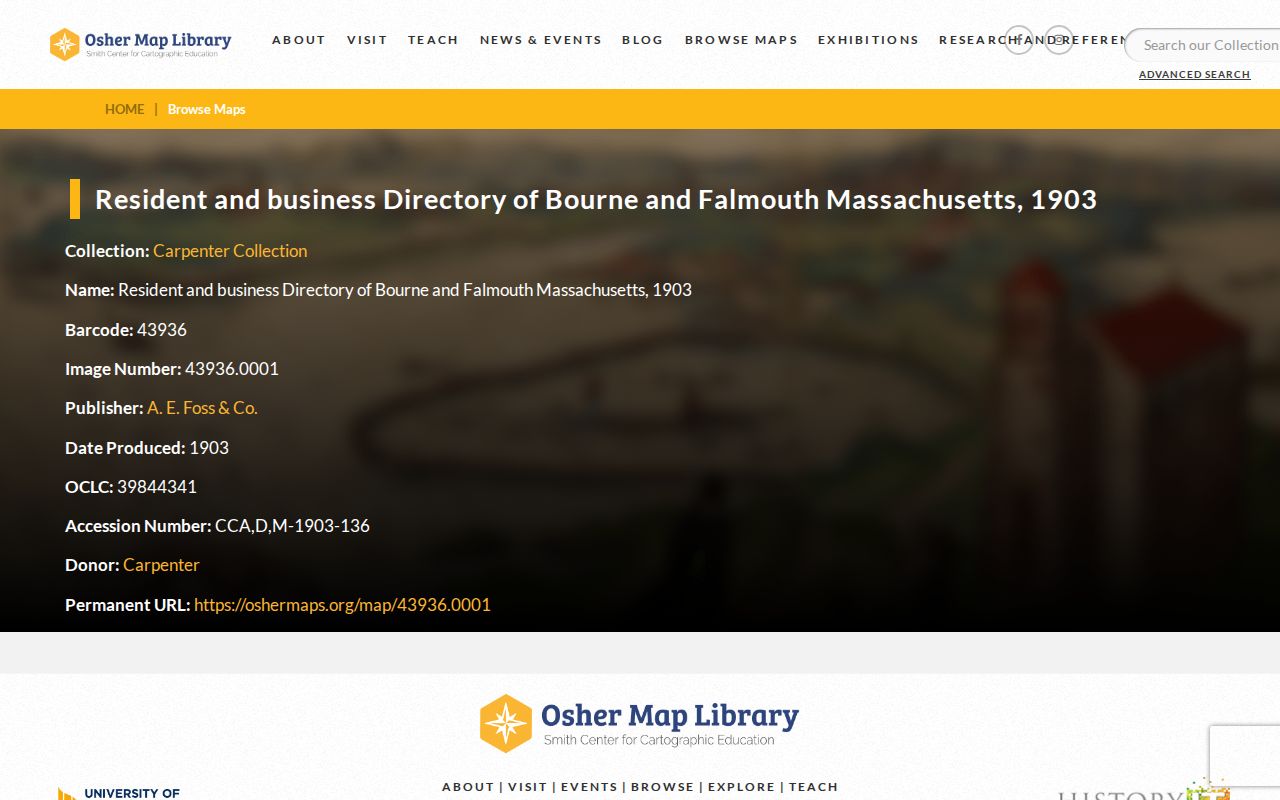
That item gives the directory a firm, dated starting point, but the entry itself still needs to be read in its original geographic context.
For a household search, copy the spelling and initials exactly as printed. A directory is a snapshot of an address association and possible business connection. It does not establish ownership, every person in a home, or a person’s location outside the volume’s publication period.
Bourne Directory Years
The documented Bourne directory windows are 1900, 1903, 1908, 1926, and 1929, with a Boston Public Library catalog lead extending through 1931. NARA’s listing is a collection-level statement for a regional volume, not an assurance of equal coverage for each Bourne village. Treat a missing surname as a reason to try initials, a name variant, a nearby year, and the old village label rather than proof that the person was absent.
- Write down the exact person, village, street, and approximate year before opening a volume.
- Check the closest documented Bourne directory year and transcribe the entry without expanding abbreviations.
- Compare a second directory year for a move, a changed occupation, a widow notation, or a new business association.
- Pair the directory window with the 1900, 1910, 1920, or 1930 federal census, which answers household questions differently.
- Use a deed, vital record, obituary, or probate record to test a lead created by the book.
Federal census records are released under the 72-year rule, and Jonathan Bourne Public Library provides in-library access to Ancestry Library Edition and HeritageQuest. The directory and census should not be merged as if they were made on the same day.
Note: A cataloged year is a useful search target, but inspect the item before treating it as a complete Bourne household roll.
Where Bourne Directories Rest
The Massachusetts State Library genealogy guide describes city and town directories, voting lists, house guides, business listings, and New England genealogy material. Ask staff for Bourne and nearby Cape items by the year and village needed. The Jonathan Bourne Public Library’s genealogy resources add in-library Ancestry, Fold3, and HeritageQuest. Its published page does not name a Bourne printed-directory or obituary run, so contact reference staff before making a trip for a particular year.
For material that is fragile, unpublished, or only partly cataloged, use Bourne Archives and the Jonathan Bourne Historical Center. The Archives lists public hours on Tuesdays from 9:30 a.m. to 2:30 p.m. and takes appointments. The Historical Center at 30 Keene Street lists Tuesday hours from 10 a.m. to 2 p.m. and appointments. Send a surname, address, village, and date range in advance. Historical collections are used under repository rules; a town public-record request belongs with the Town Clerk when the target is a municipal record.
Reading a Bourne Directory Entry
A Bourne directory is most useful when each printed clue stays attached to the page where it appears. The collection description supports surname-organized residents and possible address or house-guide sections, but it does not prove that every volume uses the same fields. The 1903 item is a resident-and-business book, so copy the title, page, village heading, spelling, initials, street text, occupation or business association, and any printed household wording that actually appears.
| Name | Transcribe the surname, given name, and initials exactly as printed. |
|---|---|
| Place | Record the village heading and street or address text before converting it to a modern label. |
| Work or business | Copy an occupation or business association only when the entry prints one. |
| Household wording | Preserve any spouse, widow, boarding, or owner notation shown on the page rather than assuming it exists. |
| Source detail | Keep the year, volume title, page, and image reference so another reader can check the reading. |
- Criss-cross directory
- A street-order section, if a volume contains one, that can be checked for an address after the surname entry is found.
- Householder index
- A resident list organized around household or surname access rather than an assertion that every occupant is named.
- Abbreviation key
- A key usually printed in the volume when abbreviations are used. No Bourne page-level key was captured, so photograph it only if the book provides one.
A directory entry can point to a person, but it should not be used as a present-day address claim. When a historic name needs modern confirmation, use the focused records on the Bourne resident lookup page.
Bourne Directories and Village Names
Bourne was incorporated from part of Sandwich in 1884, and the town’s record geography carries older labels. North Sandwich later divided into Sagamore and Sagamore Beach. West Sandwich became Bournedale. Monument appears as Bourne Village, while Cohasset and Head of the Bay became Buzzards Bay. A historical-directory search that uses only a current village name can miss the book’s older heading.
The Cape Cod Canal changed the physical landscape around 1913, including the destruction of Jonathan Bourne’s birthplace during digging. Use the town’s historical maps page, boundary maps, and legal descriptions to bridge an old directory location with a modern one. The 1880 and 1906 atlases and the later Sanborn material help establish roads and structures, not who occupied a building.
Bourne Directory Companions
Bourne Archives collections bring together town records, family material, photographs, maps, village files, cemetery documentation, property material, and digitized high-school yearbooks. The collection description also identifies local vital certificates from 1884 through 1914. These sources can test a directory lead after Bourne’s incorporation, especially when a surname, village, or school connection appears in more than one item.
The Bourne Archives collections page illustrates the range of locally held material that can sit beside a directory entry.
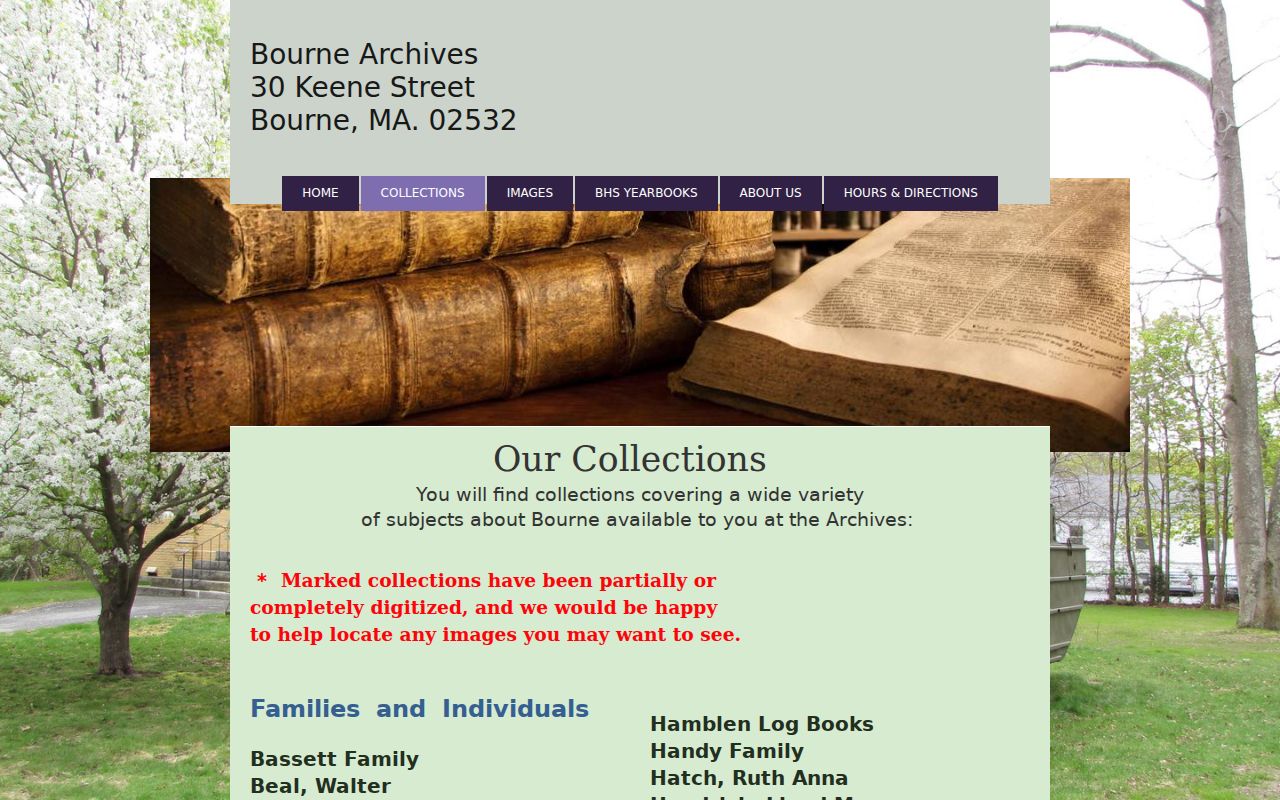
Archives material adds local context, but a cemetery image, yearbook page, or map is not by itself proof that someone lived at a particular address.
Ask for a village file, cemetery survey entry, photograph caption, yearbook page, map reference, and family collection using the same spelling variants. For a pre-1884 person, add Sandwich and Barnstable sources because the place may predate Bourne’s town records.
Tracing Bourne Families Through Directories
Family-history work works best as a dated chain. Start with the directory year closest to the person’s known address or village. Then move outward to the neighboring directory years and the census decade. A change in spelling, initials, address, or occupation is a lead to check, not a conclusion. The Barnstable Registry of Deeds can supply the title trail when the question becomes who owned a parcel, while town vital, cemetery, obituary, and probate records can explain a death or inheritance endpoint.
Keep a small evidence note for every Bourne result: the volume title, page, year, village heading, exact spelling, address text, and the record it will be compared against. A surname can recur across villages, and the combined Bourne/Falmouth volume makes its heading especially important. If a person seems to vanish, test a spouse’s surname, a middle initial, a widow notation, a nearby village, and the earlier Sandwich labels before deciding the trail ended. The record date matters as much as the name because a directory, deed, map, and census each describe a different kind of connection.
When no online image answers the question, use the fallback sequence: ask the State Library or Jonathan Bourne Public Library for the specific volume, arrange an Archives visit or appointment for local material, and send a bounded request to the Town Clerk for an identified municipal record. Massachusetts Public Records Law, M.G.L. c.66, §10, governs existing municipal-record requests, but it does not turn private or repository-held material into an open online index.
Note: Preserve the citation for each Bourne directory entry, because a later correction is easier when the volume and page remain known.